CONVENIENCE STORE INTELLIGENCE: High-Velocity SKU Strategy & Direct Delivery Models
Convenience store procurement teams are shifting toward high-velocity SKU models and direct supplier delivery to improve store economics and reduce distributor margins in a channel facing declining foot traffic and rising operating costs.
Market Overview
Convenience stores represent the most fragmented retail channel in grocery distribution, with procurement models varying drastically by chain size, location (urban vs. rural), and format (standalone vs. forecourt). Q3 2026 sees accelerated consolidation, with 40%+ of independent c-stores partnering with larger buying groups to compete on procurement economics.
Channel-Specific Dynamics
Fragmented Buyer Base Unlike supermarkets and hypermarkets with centralized procurement, c-store buying is split between:
- Large chains (1,000+ stores) with centralized procurement
- Mid-sized chains (50-500 stores) with regional buyers
- Independents & small chains (<50 stores) buying through wholesalers/buying groups
This fragmentation means supplier routes-to-market vary dramatically by store type.
High Shrink & Freshness Requirements C-store shelf life is typically 50% shorter than supermarkets due to space constraints and slower category-specific velocity. Suppliers must manage frequent micro-orders and shorter delivery cycles to minimize waste.
Private Label Penetration Lower C-stores carry 5-12% private label (vs. 20%+ in supermarkets), focusing on impulse categories (snacks, beverages, ready-to-eat meals) rather than dry goods.
Procurement Model Priorities
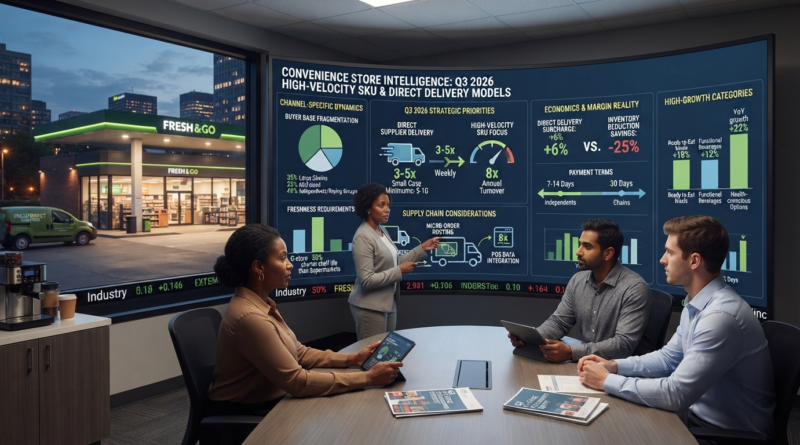
Direct Supplier Relationships C-store chains are increasingly bypassing distributors for key categories (beverages, snacks, ready-to-eat), reducing layers and improving margin capture. Direct routes require suppliers to support:
- Small case minimums (5-10 cases vs. 50-100 in hypermarkets)
- Flexible delivery schedules (3-5x weekly)
- Store-level data sharing (POS, inventory)
High-Velocity SKU Focus C-store procurement prioritizes SKUs with turnover >8x annually. Slow-movers are delisted ruthlessly, with shelf space reserved for bestsellers and new innovation.
Convenience-Packaged Formats Single-serve, grab-and-go, and portion-controlled products outpace bulk sizes 3:1 in c-store growth. Procurement teams actively seek suppliers offering convenience formats at competitive landed costs.
Economics & Margin Reality
- Average transaction value: £2.50-4.50 (lower than supermarkets; margin depends on category mix)
- Direct delivery surcharge: 5-8% cost premium vs. distributor delivery, but justified by inventory reduction
- Payment terms: Often 7-14 days for independents; 30 days for large chains
- Volume thresholds: 20-30% lower than supermarket minimums, but higher frequency demands
High-Growth Categories
- Ready-to-eat meals: +18% YoY (sandwiches, salads, wraps)
- Functional beverages: +12% YoY (energy drinks, protein shakes)
- Snacking/portions: +15% YoY (smaller format, premium snacks)
- Health-conscious options: +22% YoY (low-calorie, plant-based, high-protein)
Supply Chain Considerations
Delivery Logistics C-store direct delivery requires different vehicle routing (multiple stops, smaller loads) than supermarket/hypermarket distribution. Suppliers must evaluate cost-benefit of:
- In-house direct delivery (high control, high cost)
- 3PL regional hub models (cost-efficient but less flexible)
- Hybrid with distributor for secondary categories
POS Data Integration Large c-store chains increasingly share real-time POS data with suppliers, enabling demand-driven replenishment and reducing forecasting errors by 20-30%. Suppliers lacking POS integration face delisting or reduced shelf space.
Inventory Management C-store shelf space is premium (average 300-400 SKUs vs. 8,000+ in supermarkets). Suppliers must maintain 85%+ on-shelf availability; stockouts result in immediate delisting.
Frequently Asked Questions
Q: What’s the minimum case order for c-store suppliers? A: Typically 5-20 cases per SKU depending on store format and product category. Independents ordering through buying groups may face 10-case minimums. Large chains can drop to 3-5 case minimums for strategic SKUs.
Q: How often do c-store buyers expect replenishment? A: Large chains typically reorder 2-5x weekly depending on velocity. Independents may order weekly. High-velocity categories (beverages, snacks) require 3-5x weekly replenishment.
Q: Can suppliers negotiate payment terms with c-store chains? A: Large chains enforce 30-day terms firmly. Independents often operate on 7-14 day cycles. Early-payment discounts (2-3%) may be available, but extended terms beyond standard are rare.
Q: Which product formats perform best in c-stores? A: Single-serve, convenience-packaged, and ready-to-eat formats outsell bulk/family sizes 3:1. Premium positioning at higher price points performs better than commodity/value positioning.
Q: How does distributor vs. direct delivery impact c-store profitability? A: Direct delivery reduces c-store holding costs by 20-30% but adds 5-8% cost per unit. Break-even occurs at ~300-500 stores in a region; smaller chains benefit from distributor networks.
Q: What’s the typical shelf-life expectation for c-store fresh products? A: 5-7 days for ready-to-eat meals; 10-14 days for ambient fresh (salads, wraps). Suppliers must guarantee minimum 50% shelf-life remaining on delivery.
Sources & Industry Data
- Convenience Store Association Regional Market Report Q3 2026
- National Retail Federation — C-Store Operator Economics Study
- POS Analytics Consortium — Velocity & Shrink Benchmarking
- Supply Chain Council — Direct Delivery Cost Analysis