Supermarkets Are Watching Walmart. Costco Is Quietly Eating Their Lunch.
Costco’s 8.3% grocery share, mid-single-digit fresh comps and a value edge over Aldi make the club giant a threat supermarkets can no longer afford to ignore.
For years, traditional grocers have built their competitive playbooks around Walmart, Amazon, Aldi and the dollar chains. That focus now looks incomplete. Costco, the membership warehouse club once treated as a bulk-buy side trip, is winning in the exact departments that define a supermarket’s identity: fresh meat, bakery and everyday food.
Costco’s grocery numbers keep climbing
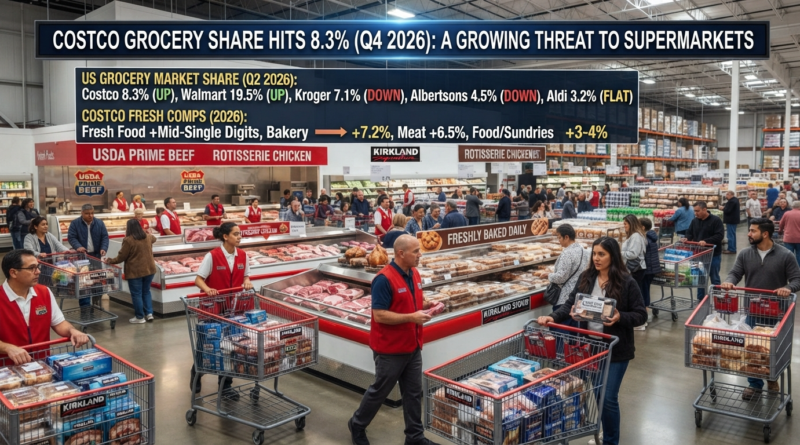
The data tells a clear story. Costco’s US comparable-store sales excluding fuel rose 7.2% in its fiscal fourth quarter, which ended on 30 August 2026. That result continued a run of quarterly improvement that started at the beginning of the year.
Fresh food was a standout. Fresh comparable sales grew in the mid-single digits, with bakery and meat leading the way. Food and sundries grew more modestly, in the low-to-mid single digits, driven by packaged and frozen lines.
Market share is moving in the same direction. Numerator data puts Costco’s US grocery share at 8.3% at the end of June 2026, up from 7.9% a year earlier and 7.6% in mid-2024. Over the same period, Kroger and Albertsons have seen their shares contract, while Costco, Walmart and Amazon have all gained ground.
Why fresh is the real battleground
Fresh departments have long been the supermarket’s defensive moat. Shoppers might buy paper towels and cereal anywhere, but meat, bakery and produce drive store choice and visit frequency.
Costco’s gains in exactly these categories matter more than its headline sales growth. When a warehouse club becomes a primary destination for proteins and baked goods, it erodes the trip that traditional grocers rely on to sell higher-margin items around the store.
Costco has also moved quickly on emerging demand. Earlier in 2026, it launched protein-focused private label products aimed at shoppers using GLP-1 weight-loss medications, a fast-growing segment many grocers are still working out how to serve.
The value perception gap
Perhaps the most uncomfortable signal for supermarkets is how shoppers see Costco on price. Recent YouGov research found that US consumers rate Costco ahead of Aldi on value perception. The gap was especially wide among younger shoppers.
That result is striking because Costco charges a paid membership fee just to walk through the door. Aldi, by contrast, has built its entire brand on low prices with no barrier to entry. If shoppers still believe Costco delivers better value, the membership model is clearly not a deterrent.
What this means for grocery buyers and operators
For procurement teams and category managers at traditional grocers, several implications stand out:
- Fresh pricing and quality will face more scrutiny. Shoppers comparing meat and bakery against club pricing will expect sharper value at the supermarket shelf.
- Private label must earn its place. Costco’s own-brand strategy shows how quickly a strong private label can respond to new consumer needs such as high-protein diets.
- Competitive monitoring needs to widen. Benchmarking against Walmart and discounters alone may miss the share being lost to club stores.
- Trip frequency is the metric to protect. Supermarkets win when they are the convenient top-up stop between larger shops. Losing fresh trips weakens that role.
The bottom line
Costco is not a supermarket, and it does not need to be one to take share from them. With strong fresh comps, steady annual share gains and a value reputation that beats a leading discounter, the club retailer has earned a place at the top of every grocer’s competitor list. Whether it is the industry’s single biggest threat is debatable. That it is a serious and growing one is not.
FAQ
What is Costco’s share of the US grocery market? Numerator data put Costco’s US grocery market share at 8.3% at the end of June 2026, up from 7.9% a year earlier.
How did Costco perform in its latest quarter? In fiscal Q4 2026 (ended 30 August 2026), Costco’s US comparable-store sales excluding fuel rose 7.2%, with fresh comps up in the mid-single digits.
Which grocery departments are driving Costco’s growth? Bakery and meat led fresh-food growth, while packaged and frozen foods drove the broader food and sundries category.
Do shoppers think Costco is better value than Aldi? Yes. YouGov research found US consumers, particularly younger ones, rate Costco ahead of Aldi on value perception despite its membership fee.
Why should traditional grocers be concerned? Costco is gaining share in fresh categories that traditionally drive supermarket visits, while major chains such as Kroger and Albertsons have lost share.